

A 2 Day Mediation Communication Lab: Training Future Mediators on The Art of Dialogue
First Principles of Effective Communication - Day 1
Effective legal practice requires more than substantive legal knowledge and analytical ability. It also depends upon the ability to communicate with clarity, precision, empathy, and purpose. These skills are particularly important in client counselling, negotiation, advocacy, Mediation, and dispute resolution.
Recognising the importance of effective communication in legal practice, the GITAM Mediation Centre, GITAM School of Law, organised an insightful session on “First Principles of Effective Communication” on 24th August 2026, with Dr. Shanice Anne Ranade as the resource person. The session introduced students to fundamental principles of effective communication and explored their practical application in legal practice and dispute resolution.
Active Listening: What Lies Beneath
The session examined the distinction between hearing and active listening and introduced the Iceberg Model to demonstrate how expressed positions may represent only the visible aspect of communication, while interests, emotions, expectations, and concerns may remain beneath the surface.
Students also explored open-ended questioning, clarification, purposeful silence, empathy, neutrality, tone, pace, clarity, and body language. These principles highlighted the importance of looking beyond spoken words to understand the underlying concerns and interests that influence communication.
Communication in Professional Practice
The session emphasized on the importance of effective communication in important areas of legal practice.
Learning Through the Chinese Whispers Activity
An interactive Chinese Whispers activity demonstrated how information can become distorted through inattentive listening, assumptions, interpretation, and imprecise expression.
The activity provided students with a practical understanding of how communication gaps can affect the accuracy of information and reinforced the importance of attentive listening and precise expression.
Key Learning Outcomes
The session strengthened students’ understanding of active listening, purposeful questioning, clear expression, empathy, professional neutrality, and verbal and non-verbal communication.
The session provided a practical foundation for client interviewing, fact-gathering, negotiation, advocacy, mediation, and dispute resolution.
Communication in Conflict – Day 2
Legal practice frequently involves conversations shaped by disagreement, competing interests, heightened emotions, and differing perspectives. In such situations, effective communication requires more than clear expression. It calls for attentive listening, empathy, adaptability, self-regulation, and the ability to engage constructively with opposing viewpoints.
Building upon the foundational principles introduced earlier, the GITAM Mediation Centre, GITAM School of Law, conducted a session on “Communication in Conflict and Difficult Conversations” on 25 August 2026, with Dr. Pronema Bagchi as the resource person. The session focused on developing students’ ability to communicate effectively in situations involving conflict, pressure, misunderstanding, and competing interests.
Communication Across Four Dimensions
The session examined communication through the interconnected dimensions of listening, speaking, reading, and writing. Students explored how each dimension contributes to effective professional engagement and how weaknesses in one area can affect the overall quality of communication.
Word Chain – Positive Synonyms
Particular attention was given to neutral language, strategic questioning, self-regulation, purposeful silence, and reframing. Students examined how deliberate choices in language, tone, timing, and delivery can help prevent unnecessary escalation, clarify concerns, and create space for constructive dialogue.
The principles of neutral communication were reinforced through the Word Chain – Positive Synonyms activity. Students identified constructive alternatives to potentially confrontational expressions and considered how changes in vocabulary can influence the tone of an interaction.
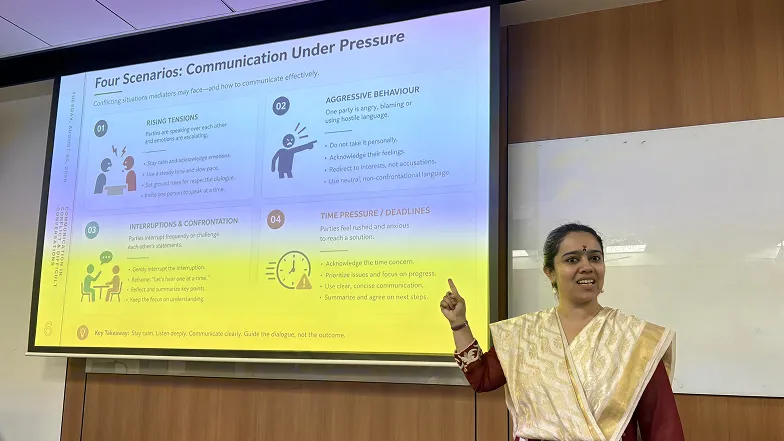
Communication Under Pressure
The Communication Under Pressure activity placed students in challenging situations involving escalating tension, interruptions, aggression, communication breakdowns, and time constraints.
The exercise allowed students to observe how pressure can affect communication and decision-making while practising clarity, composure, neutrality, and professionalism.
Key Learning Outcomes
By the end of the session, students strengthened their understanding of self-regulation, strategic questioning, neutral and constructive language, reframing, purposeful silence, and communication under pressure.
The session provided a practical foundation for client conferences, negotiation, advocacy, mediation, and dispute resolution.
Gallery